
Criminal Court Records in Wayne County
A Wayne County criminal court record is the case file a court opens once a prosecutor files charges. It is a case-level record. One file holds every charge, hearing, and order tied to a single defendant. The Wayne County Clerk Criminal Division initiates felony cases that are bound over from the county's district courts. Once the file opens, the Wayne County Clerk logs each event in order. That log runs from the first charge to the final sentence, and it stays with the Wayne County court that heard the case.
Two court levels produce these Wayne County records. District and municipal courts handle misdemeanors, first arraignments, and the felony preliminary examination. Felonies that clear that stage move to the Third Judicial Circuit Criminal Division. That division sits inside the Wayne County Criminal Justice Center at 5301 Russell Street in Detroit. The Wayne County circuit court runs the trial, the plea, and the sentence. So one felony can leave a trail in two courts, with a district file for the early steps and a circuit file after bindover.
The criminal file is only part of the wider set of Wayne County court records. It differs from the civil, family, and probate files the same Wayne County Clerk keeps. The focus here is the criminal case: what a prosecutor charged, how the court handled it, and how it closed.
Stages of a Wayne County Criminal Case
A Wayne County criminal case moves through set stages, and each one leaves a mark in the Wayne County record. The path starts with an arrest and a Wayne County prosecutor's decision to authorize a warrant. The Wayne County Prosecutor's District Courts Section explains the early steps. After arrest and warrant authorization, the defendant is brought before a Wayne County district or municipal judge or magistrate. Charges are read. Rights are explained. Bond is set. A preliminary examination date is scheduled.
Case flow: Arrest › District/Municipal Arraignment › Preliminary Examination › Bindover › Circuit Arraignment on the Information › Pretrial › Plea or Trial › Disposition › Sentencing
The preliminary examination is the hinge for a felony. A district or municipal judge decides whether there is probable cause that a crime occurred and that the defendant committed it. If the judge finds it, the case is bound over to the Third Circuit at the Wayne County Criminal Justice Center. The clerk then opens the circuit file and the case is arraigned again on the information, which is the formal charging document filed after bindover. From there the case runs through pretrial motions, a plea or trial, a disposition, and a sentence.
| Stage | What Happens |
|---|---|
| District/Municipal Arraignment | Charges are read, rights explained, and bond set before a district or municipal judge or magistrate. |
| Preliminary Examination | The district judge weighs probable cause for a felony and decides whether to bind the case over. |
| Bindover | The felony transfers to the Third Circuit, and the Clerk Criminal Division opens the circuit file. |
| Circuit Arraignment on the Information | The defendant is arraigned on the information, the formal charging document filed in circuit court. |
| Pretrial / Motions | Both sides file motions, exchange discovery, and litigate issues before trial. |
| Plea or Trial | The case ends by plea, or a judge or jury decides guilt at trial. |
| Disposition | The outcome of each charge is entered, such as guilty, dismissed, or acquitted. |
| Sentencing | After a conviction, the judge orders the penalty and any costs, restitution, or probation. |
Note: A felony that begins in a Wayne County district court and is later bound over will show up in both a district record and a separate circuit court record.
Search Wayne County Criminal Court Records
The main path for Wayne County circuit criminal cases is the Third Circuit's Odyssey Public Access system, known as OPA. The Third Judicial Circuit case search lets the public view case records, registers of action, and judgments. It does not post party-filed document images online. The search offers three categories: Criminal Case Records, Non-Criminal Case Records, and Court Calendar.
- Open the Odyssey Public Access page from the Third Circuit site and choose the Criminal Case Records category.
- Search by defendant name or case number. You can also use an attorney name, a citation, or a filing date.
- Narrow the results by date filed or case status to find the right file.
- Open the case to read the register of actions, which lists each filing, hearing, plea, and disposition in order.
- Request a certified copy from the Wayne County Clerk if you need an official document, since images are not online.
Other Wayne County courts hold their own records. Detroit district cases appear in the free 36th District Court case inquiry, which covers public cases from 1990 to present without document images. The statewide Michigan MiCOURT Case Search may include criminal, civil, traffic, and probate cases where a court takes part. Date coverage matters for older files. The Wayne County Clerk Records Division holds criminal records from 1942 to 1983 for matters outside Detroit but within the county. For Detroit criminal records or any criminal record after 1983, the Wayne County Clerk directs people to the Criminal Justice Center records room at 313-224-2502.
What a Wayne County Criminal Record Shows
A Wayne County criminal case file is built field by field as the case moves. Some fields appear when the file opens. Others fill in at each hearing. Together they show who was charged, with what, and how the Wayne County court resolved it. The register of actions ties it all together as a dated case history. The fields below are the ones a reader will look for most in a Wayne County criminal record.
| Field | What It Shows |
|---|---|
| Case Number | The unique ID the clerk assigns when the file opens. Formats differ by court. |
| Court and Division | Which court holds the case, such as a district court or the circuit Criminal Division. |
| Defendant | The person charged in the case, listed by name. |
| Charges | Each count as filed, with the statute cited and the severity level. |
| Bond | The money amount or conditions set for release and future appearance. |
| Register of Actions | The dated list of every filing, motion, hearing, and order. |
| Plea | The defendant's formal answer, such as guilty or not guilty. |
| Disposition | The outcome of each charge once the case closes. |
| Sentence | The penalty the judge orders after a conviction. |
| Costs and Restitution | Fines, court costs, and money owed to a victim. |
Reading Dispositions and Sentences
In a Wayne County criminal record, the disposition is the outcome of a charge. The sentence is what follows a conviction. Both live in the register of actions, often near the end of the case history. Codes and short labels are common, so a few terms are worth knowing before reading a Wayne County file.
- Disposition
- The result of a charge or the whole case, such as guilty, not guilty, or dismissed.
- Nolo Contendere
- A no-contest plea, where the defendant does not admit guilt but accepts a conviction.
- Dismissed With Prejudice
- Dismissed so the same charge generally cannot be refiled.
- Dismissed Without Prejudice
- Dismissed but open to refiling if the law allows.
- Probation
- Supervised release in the community under conditions the court sets.
- Restitution
- Money the court orders a defendant to pay to compensate a victim.
A sentence line can list jail or prison time, probation length, fines, costs, and restitution. Wayne County dockets sometimes show repeat review hearings instead of a simple plea and sentence. That pattern often means the case ran through a Wayne County specialty court, such as a drug, mental health, or veterans docket, which tracks treatment and compliance over many months.
Charges vs. Convictions
Being charged is not the same as being convicted. A charge is an accusation. A conviction is a finding of guilt by plea or verdict. A Wayne County criminal court record can show charges that were later dropped, dismissed, reduced, or that ended in acquittal. Reading only the charge, and not the disposition, is the most common mistake people make with these files. For a closer look at how charges are filed and how they change, see the Wayne County arrest records and court charges page.
| Charge | Conviction | |
|---|---|---|
| Stage | Accusation at the start | Verdict or plea at the end |
| Burden of Proof | Probable cause | Beyond a reasonable doubt |
| Who Decides | The prosecutor files it | A judge or jury finds it |
| Meaning | Guilt not yet proven | Guilt established in court |
| Public Record | Yes | Yes |
Note: A dismissed charge still appears in the Wayne County case history, so a record can show an arrest and charge that never led to any conviction.
Wayne County Criminal Court Costs
Wayne County criminal cases carry money obligations, and they show up in the record. A conviction can bring fines, court costs, and restitution to a victim. Defendants also pay to obtain copies of their own Wayne County files. The Third Circuit runs a central counter for adult criminal payments at the Wayne County Criminal Justice Center. The Third Circuit payment instructions explain how to pay assessments online, by phone, or in person.
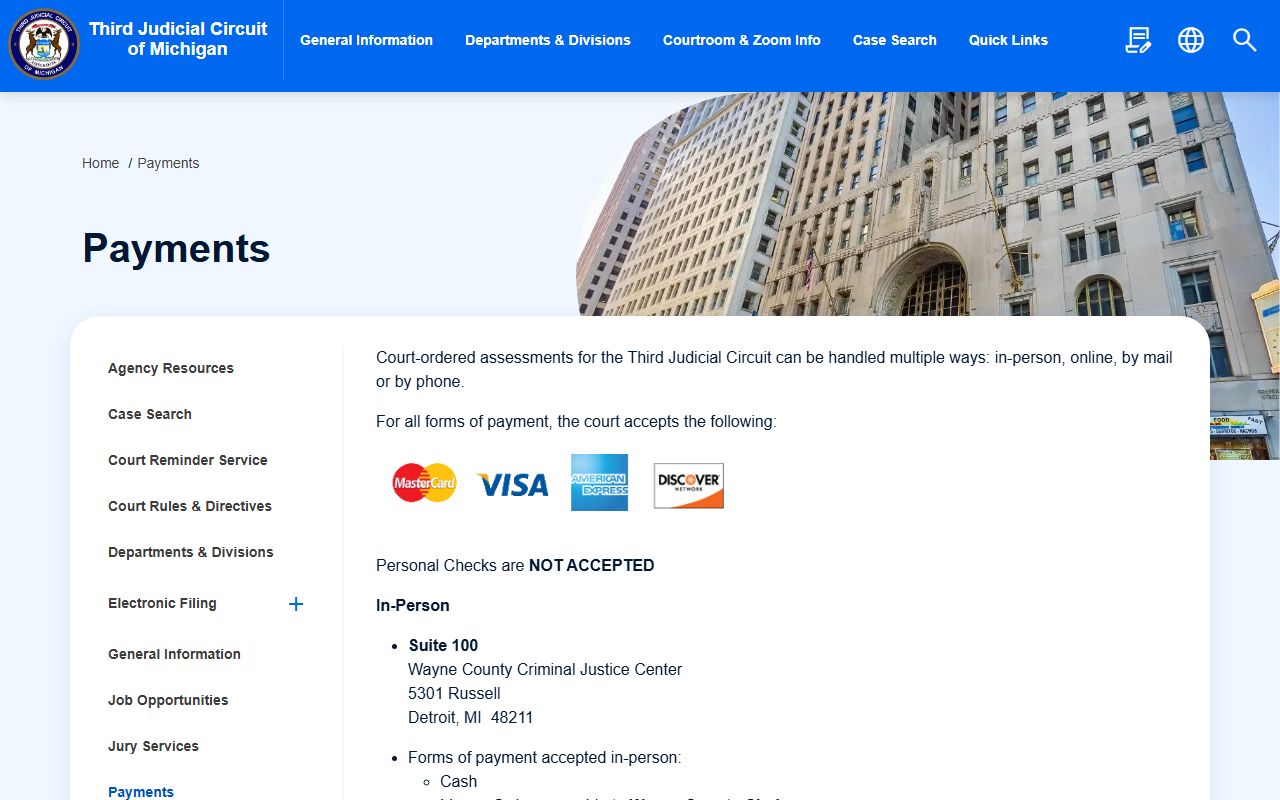
An adult criminal payment needs the payment amount, the defendant's full name, the case number, and the defendant's date of birth. Copy fees are separate. The Wayne County Clerk Criminal Court Services fee list sets a record search at $1 per name, non-certified copies at $2 per page, and transcript copies at $0.30 per page. A certified or authenticated copy adds a $10 seal plus $1 per page. A certified letter stating no record was found costs $10 plus $1 per page.
Public Access to Wayne County Criminal Records
Court case records in Michigan are governed by court rules, not by ordinary county open-records law. The main authority is Michigan Court Rule 8.119, which sets clerk record duties, public access, and the limits on it. A related rule defines court records broadly and routes access requests through that rule. The Michigan Courts records management guidance notes that access generally exists unless a statute, rule, or court order restricts it. It also explains why portals show dockets but not document images: courts are barred from posting party-filed images on the internet.
Key Rules and Statutes:
Michigan Court Rule 8.119 - The core rule on court records, clerk duties, public access, and restrictions.
Michigan FOIA, MCL 15.231 - Covers county and agency records, though court case files fall under the court rules instead.
Note: Because full document images are not online, a docket search finds the case, but a certified copy still comes from the Wayne County Clerk or the Criminal Justice Center records room.
Sealed vs. Set Aside Criminal Records
Two different tools can pull a Wayne County criminal record out of ordinary public view. A record is sealed when a court orders public access shut off, sometimes in matters that involve domestic-violence or sexual-assault allegations. A conviction is set aside, the term Michigan uses for expungement, when the state treats it as nonpublic under its Clean Slate law. Set-aside is the more common path for old convictions. The Michigan State Police Clean Slate page explains which convictions clear automatically and which need an application. Eligibility runs under Michigan's adult set-aside statute, MCL 780.621.
| Sealed | Set Aside (Expunged) | |
|---|---|---|
| Visibility | Hidden from public view | Nonpublic for most public searches |
| Law Enforcement | Limited access | Police, courts, and some agencies keep access |
| How It Starts | By motion and court order | Automatic after a waiting period, or by application |
| Eligibility | Certain case types by statute or order | Eligible adult convictions under Clean Slate |
The waiting period is a key gate for set-aside. It runs from the sentence, release, or completion of probation, and its length depends on the offense. The Michigan set-aside waiting period statute lays out those timelines.
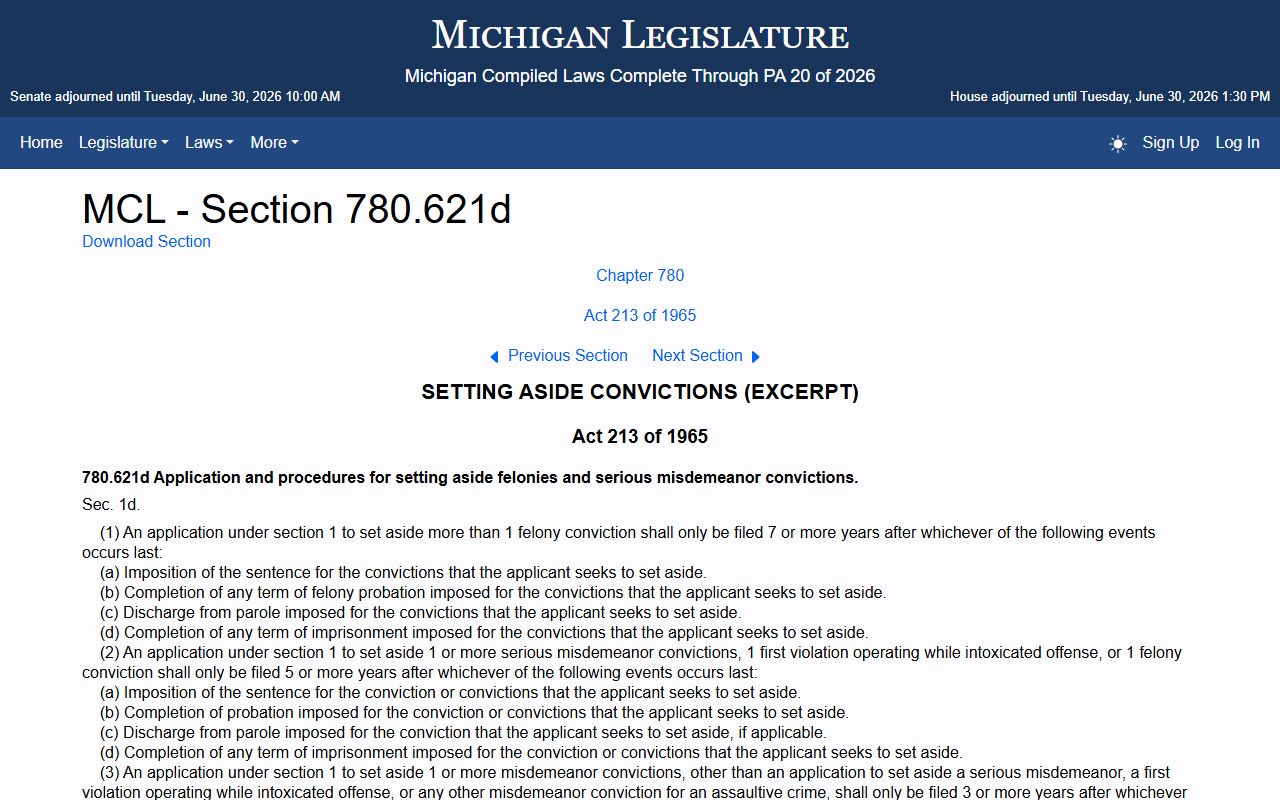
An application to set aside a conviction is filed in the court where the conviction happened, so a Wayne County Third Circuit felony and a district-court misdemeanor take separate applications. Certified copies of each conviction are required with the filing.
Restricted Wayne County Criminal Court Records
Not every Wayne County criminal file is open. Some categories of Wayne County records are restricted by statute, court rule, or court order. Juvenile matters are the clearest example, since they can hold minor names, evaluations, placement details, and social-service material. Sealed and set-aside cases drop out of ordinary public searches. Wayne County courts also strip protected personal information from public files. That includes dates of birth, Social Security numbers, financial account numbers, and driver license or state ID numbers.
- Juvenile delinquency and child-protection cases, handled through the Wayne County family division.
- Adoption records, which are open only to parties, agencies, or people with a court order.
- Sealed cases removed from public access by court order.
- Set-aside convictions that are now nonpublic under Clean Slate.
- Mental health and developmentally disabled proceedings held in probate court.
- Protected personal identifying information redacted from otherwise public files.
Important: Wayne County Court Records is not a consumer reporting agency, and these records may not be used for employment, credit, tenant, or other FCRA-regulated screening.